
In 1954, Ray Kroc visited the McDonald brothers in San Bernardino to see why they were making so many milkshakes. The 52-year-old milkshake mixer salesman had spent decades in various sales jobs, never quite finding his breakthrough. What he witnessed that day would change his life and revolutionise the restaurant industry. A streamlined hamburger stand serving customers with unprecedented speed and efficiency.
Within a year, Kroc opened his first franchise location. By his death in 1984, McDonald's had 7,500 outlets in the United States and in 31 other countries and territories, with total system-wide sales of more than $8 billion in 1983. This wasn't just business success. It was the creation of a franchise model that would be studied, copied, and admired for generations. Understanding how Ray Kroc transformed a single innovative restaurant into a global empire offers essential lessons for anyone considering franchise entrepreneurship.
The Brothers and The Salesman
Dick and Mac McDonald moved to California to seek opportunities they felt were unavailable in New England. Failing in the movie business, they subsequently proved successful in operating drive-in restaurants. Their real innovation came in 1948 when they took a risk by streamlining their operations. They introduced their Speedee Service System featuring 15-cent hamburgers.
The Speedee Service System was revolutionary. The brothers reduced their menu from 25 items to just nine, focusing on hamburgers, fries, and milkshakes. They eliminated carhops and table service, replacing them with a walk-up counter. Most importantly, they applied assembly-line principles to food preparation, allowing them to serve customers in seconds rather than minutes. The result was fast, cheap, consistent food that created lines around the block. See the video below, taken from the film ‘The Founder’.
When Kroc arrived in 1954, the McDonald brothers operated six franchise locations. They had proven their concept worked and could be replicated. But the brothers were cautious about expansion, sceptical that their California-based system would succeed elsewhere. Kroc offered to assume the major responsibility for establishing the new franchises elsewhere. He returned to his home outside of Chicago with the rights to set up McDonald's restaurants throughout the country. Except for a handful of territories in California and Arizona, which the McDonald brothers already licensed.
The First Franchise: Des Plaines, Illinois
On April 15, 1955, Kroc opened his first McDonald's in Des Plaines, Illinois. First day sales were $366.12. This wasn't just another McDonald's location. It was the prototype for Kroc's vision of a nationwide chain.
The building itself made a statement. The attention-getting red-and-white tiled building with the Golden Arches was designed by architect Stanley Meston in 1953. The architecture announced that something new and exciting was happening.
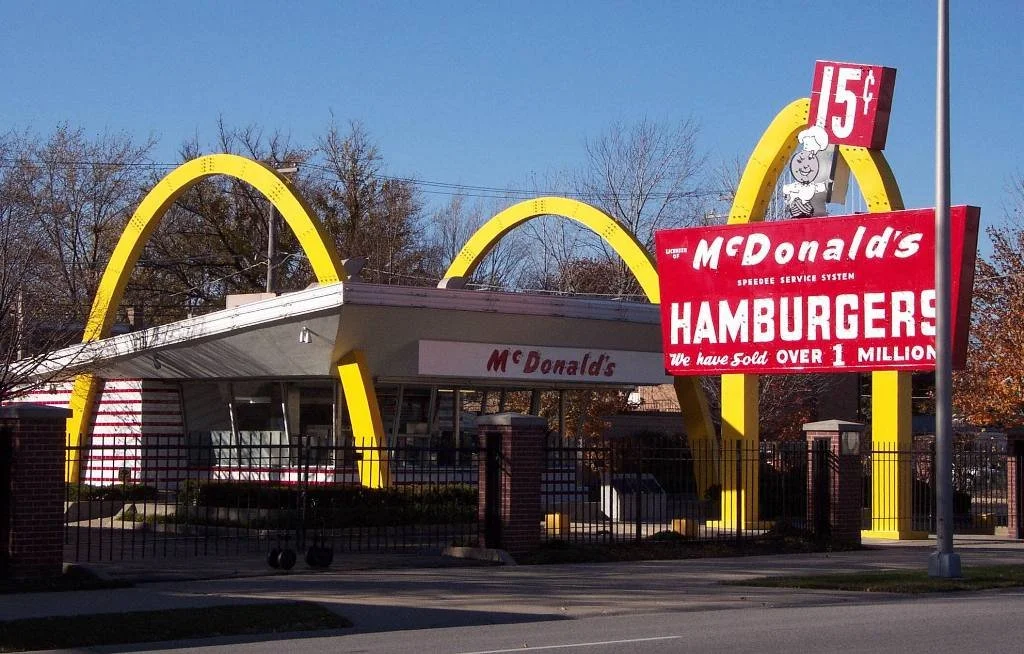
The first McDonald’s opened by Ray Kroc
But Kroc's ambitions far exceeded opening successful individual restaurants. He wanted to create a system. A replicable formula that could produce identical results in any location. This required more than copying the McDonald brothers' operations. It demanded obsessive attention to standardisation, quality control, and franchisee selection.
The Standardisation Revolution
What distinguished Kroc from other franchisors was his fanatical commitment to consistency. He set strict rules for franchisees on how the food was to be made, portion sizes, cooking methods and times, and packaging. Kroc also rejected cost-cutting measures, such as using soybean filler in hamburger patties.
Every detail mattered. How long have the fries been cooking? How many pickles went on a burger? How floors were mopped. How employees greeted customers. Kroc developed detailed operations manuals that outlined every aspect of running a McDonald's restaurant. These manuals covered everything from cooking fries to mopping the floors. This wasn't micromanagement for its own sake. It was the key to building customer trust.
To ensure franchisees understood and maintained standards, Hamburger University opened in the basement of the McDonald's restaurant in Elk Grove Village, Illinois, in 1961. This training facility taught franchisees and managers the entire McDonald's system. The curriculum wasn't just about cooking techniques; it also covered comprehensive business operations, including food safety, customer service, employee management, and financial controls.
Hamburger University wasn't a gimmick. It was essential infrastructure for maintaining quality at scale. Since 1961, it has graduated over 80,000 franchisees, managers, and employees, ensuring that everyone operating a McDonald's location understands not just procedures but the philosophy behind them.
The Real Estate Breakthrough
By 1959, Kroc had achieved significant expansion. McDonald's had opened its 100th restaurant, but Kroc still wasn't reaping significant profits. The franchising fees weren't generating enough revenue, and many potential franchisees lacked the capital to purchase land and build restaurants.
Enter Harry Sonneborn, who would become McDonald's first CEO. In 1956, Ray Kroc met Harry J. Sonneborn, who offered an idea to accelerate the growth of Kroc's planned McDonald's operation.
To own the real estate upon which future franchises would be built.
The strategy was brilliant in its simplicity. Kroc hired Sonneborn. His plan was executed by forming a separate company, Franchise Realty Corp, to hold McDonald's real estate. The new company signed leases and procured mortgages for both land and buildings, passing these costs on to the franchisee with a 20-40% markup and a reduced initial deposit of $950.
This created multiple advantages. McDonald's could expand rapidly without waiting for franchisees to secure financing. The company earned steady rental income regardless of individual restaurant performance. If a franchisee failed, McDonald's still owned valuable real estate and could find a new operator. And most importantly, owning the land gave McDonald's leverage to enforce its strict operational standards.
The "Sonneborn model" of real-estate ownership within the franchise persists to this day. It may be the most important financial decision in the company's history. Today, McDonald's real estate holdings represent $37.7 billion on its balance sheet, about 99% of its assets and 35% of its annual gross revenue.
This transformed McDonald's from merely a restaurant company into a real estate empire that happened to sell hamburgers.
The Philosophy: Single-Store Franchises
Kroc made another crucial decision that shaped McDonald's trajectory. Kroc has been credited with making several innovative changes in the food-service franchise model. Chief among them was the sale of only single-store franchises rather than larger, territorial franchises, which were common in the industry at the time.
Most franchisors at the time sold territorial rights. Granting someone exclusive rights to develop an entire region. This generated immediate capital for the franchisor but created problems. Territorial franchise owners often lacked motivation to develop all locations quickly. And franchisors lost control over how the brand was managed across large areas.
Kroc recognised that selling exclusive licenses for large markets was the quickest way for a franchisor to make money. But he also saw a loss in the franchisor's ability to exert control over the course and direction of a chain's development. He wanted uniformity across all locations, and that required maintaining influence over franchisees.
By granting a franchisee the right to only one store location at a time, Kroc retained some measure of control over the franchise. A franchisee who wanted to expand had to prove themselves first. Poor performance meant no additional locations. Excellent performance created growth opportunities. This created a meritocracy that rewarded operators who maintained standards.
The Buyout: Full Control
Despite their partnership, tensions grew between Kroc and the McDonald brothers. Kroc became frustrated with the McDonald brothers' desire to keep the number of restaurants small. The brothers also consistently told Kroc he could not make changes to things such as the original blueprint. But despite Kroc's pleas, the brothers never sent any formal letters that would have legally authorised the changes in the chain.
The brothers had achieved success and were content. Kroc was ambitious, seeing potential for a nationwide - even worldwide - chain.
In 1961, he bought the company for $2.7 million. With full ownership, Kroc could implement his vision without compromise. He further standardised operations, accelerated expansion, and built the infrastructure for sustainable growth at scale.
Innovation from Franchisees
One of the most interesting aspects of McDonald's success was that some of its most iconic products came not from corporate headquarters but from franchisees experimenting with local markets.
The Filet-O-Fish was created by Lou Groen, a McDonald's franchisee in Cincinnati, to help build volume in the predominantly Roman Catholic community where his store was located. Catholics traditionally avoided meat on Fridays, and Groen needed a non-beef option. His fish sandwich became a national menu item.
The Big Mac was developed by Owner/Operator Jim Delligatti of Pittsburgh in 1967 and added to the national menu in 1968. The Egg McMuffin was created by Owner/Operator Herb Peterson of Santa Barbara, California and added to the menu, pioneering the fast-food breakfast category.
This demonstrates the power of the franchise model. Kroc created systems and standards, but he also empowered operators with intimate knowledge of their local markets to innovate. The best ideas bubbled up from the field, were tested, refined, and then scaled nationally. This distributed innovation proved far more powerful than any centralised product development team could achieve.
The Three-Legged Stool
Ray Kroc built the business on his "three-legged stool" philosophy: McDonald's Corporation, franchisees, and suppliers. All three legs are required for the system to work.
For franchisees, initial investments range from $525,000 to $2.7 million, indicating significant personal capital at risk. This creates motivation that hired managers can't match. A franchisee's life savings depend on maintaining standards and serving customers well.
The financial structure reinforced alignment. Franchisees pay a 4% royalty on gross sales (5% for new US locations starting in 2024), plus 4% for national advertising. McDonald's succeeds when franchisees succeed because higher sales mean higher royalties.
For suppliers, Kroc built long-term partnerships rather than squeezing every penny from negotiations. He helped suppliers grow alongside McDonald's, ensuring they could meet demand as the chain expanded. This created stable supply chains and consistent product quality across all locations.
This philosophy—that all parties must win for the system to thrive—distinguished McDonald's from competitors. Kroc understood that his success depended on franchisees’ success, which in turn depended on customer satisfaction, which required quality suppliers. Optimising any single piece while neglecting others would eventually cause the system to fail.
Explosive Growth
The results spoke for themselves. Within less than 10 years of Kroc becoming McDonald’s sole owner, the chain's outlets topped 1,000. The company went public in 1965, and by the early 21st century, it operated some 34,000 outlets in more than 115 countries and territories.
Ray Kroc's vision was for 1,000 McDonald's restaurants solely in the United States. Yet, McDonald's continued to grow and expand into international markets. In 1967, it opened in Canada and Puerto Rico. Kroc's initial vision was surpassed many times over.
By the 1990s, growth was so rapid that a new McDonald's opened somewhere in the world every five hours. The Golden Arches became one of the most recognised symbols globally, synonymous with American culture and capitalism itself.
Lessons for Franchise Entrepreneurs
McDonald's journey from a single innovative restaurant to a global empire offers crucial insights for anyone considering franchise entrepreneurship.
Systems are more valuable than individual locations. Kroc didn't just open restaurants. He created a replicable system. The operations manuals, training programs, supply chains, and quality controls were the real product. Individual restaurants were merely implementations of that system.
Standardisation creates trust. Customers value predictability. Knowing exactly what to expect reduces transaction risk. This is especially valuable when people encounter your brand in unfamiliar settings. Consistency isn't boring. It's reassuring.
Control matters more than quick cash. Kroc could have sold territorial franchises and made money faster, but he chose single-store franchises to maintain control. Sacrificing short-term revenue for long-term quality and brand integrity proved the right choice.
Franchisees are partners, not customers. The three-legged stool philosophy recognised that franchisee success drove corporate success. Exploitative franchise relationships might generate revenue initially but eventually collapse as franchisees fail or rebel.
Real estate can be your moat. The Sonneborn real estate model transformed economics and created leverage. Looking beyond obvious revenue streams to find where value really accumulates can fundamentally change your business model.
Empower local innovation within global standards. Some of McDonald's most successful products came from franchisees responding to local market needs. The trick is knowing what must be standardised (preparation methods, quality standards) versus what can be customised (menu items for local tastes).
Training is infrastructure, not cost. Hamburger University wasn't an expense to minimise. It was essential infrastructure for scaling quality. Investing in franchisee education pays dividends through better operations and stronger brand protection.
Speed of execution matters. Kroc was 52 when he opened his first franchise. A reminder that it's never too late to start. But once started, he moved aggressively. Rapid expansion created momentum and competitive moats before others could copy the model.
Don't be afraid to take full control. The buyout from the McDonald brothers was expensive and risky, but necessary. Sometimes, partnership constraints prevent achieving your vision. If you believe in your plan and your partners can't align, finding a way to gain control may be essential.
Conclusion
Ray Kroc didn't invent the hamburger, the drive-in restaurant, or even the McDonald's concept. What he did was recognise a brilliant idea, understand how to systematise it, and execute relentlessly on a vision of scale that others thought impossible or undesirable.
The McDonald's franchise model became the template for countless other businesses across industries. The principles Kroc established—standardisation, training, quality control, aligned incentives, strategic real estate—are now foundational to successful franchising worldwide.
For entrepreneurs considering franchise models, McDonald's offers both inspiration and instruction. The success was neither accidental nor primarily about hamburgers. It came from obsessive attention to systems, unwavering commitment to standards, creative business model design, and the courage to bet everything on an ambitious vision.
The Golden Arches stand today as a testament not just to hamburgers but to the power of entrepreneurial vision. The franchise model enabled thousands to pursue their own version of the American dream while building something larger than any individual could achieve alone.