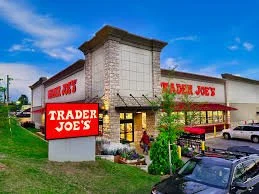
Here’s a second service innovation case study.
Trader Joe's carries roughly a tenth of the products of a typical supermarket. Its stores are small, often cramped, and rarely in prime retail locations. By every conventional retail metric, it should be an unremarkable, low-margin grocer.
Instead, it generates some of the highest sales per square foot in American retail and commands a level of customer loyalty that most premium brands would envy.
The reason is not the product. Groceries are groceries. The reason is that Trader Joe's applied experience design, usually reserved for luxury brands, to the most mundane and least glamorous service category: the weekly grocery shop.
Constraint as a Feature
Most retail innovation is about expanding choice. Trader Joe's did the opposite. It stocks around 4,000 items against the 30,000 or more found in a conventional supermarket, almost entirely private label, curated rather than comprehensive.
This is a direct illustration of a point often missed in service innovation: more options do not automatically create more value for the customer. Choice has a cost. It takes time, effort, and mental energy to navigate a supermarket aisle stocked with forty varieties of pasta sauce. Trader Joe's removed that cost entirely.
The customer trusts that whatever is on the shelf has already been selected for them. The service innovation here is not what is sold but what has been deliberately left out.
The Store as a Stage
A Trader Joe's is laid out to slow customers down and encourage discovery rather than efficient retrieval. Hand-lettered chalkboard signs, hand-drawn murals reflecting the neighbourhood, and a deliberately narrow, winding layout all work against the standard supermarket instinct to get shoppers in and out as fast as possible.
This is Pine and Gilmore's fourth stage of economic value, staged experience, applied somewhere almost nobody else bothers to apply it: routine grocery shopping.
Whole Foods and other premium grocers compete on curated product quality. Trader Joe's competes on making an errand feel like a small event, complete with staff in Hawaiian shirts and a nautical theme that has no obvious connection to groceries at all but gives the whole exercise a sense of place and character.
Employees as the Delivery Mechanism
Staff, or ‘crew members,’ are trained and given latitude to talk to customers, offer opinions on products, and hand out product samples without asking a manager first. Trader Joe's has also historically paid above the retail average and offered stronger benefits than most grocery competitors, which shows up directly in staff who seem genuinely happy to be there rather than reciting a script.
This matters because, as with any service business, quality is delivered by people and is highly variable when those people are disengaged. Trader Joe's solved the consistency problem the same way Four Seasons did, through culture and hiring rather than through rigid procedure, but transplanted the idea from five-star hospitality into a low-price grocery format where almost nobody expects it.
Discovery Instead of Selection
Trader Joe's rotates its product range constantly and builds a cult following around seasonal and limited-run items that customers actively hunt for and post about online. This turns a functional task, buying food, into something closer to a treasure hunt.
It is a clever solution to a structural problem in retail: how do you keep a fixed, familiar activity feeling fresh? The answer is not to expand choice but to constantly refresh a small selection, so returning customers are rewarded for paying attention rather than overwhelmed by an ever-growing catalogue.
The Evidence
Trader Joe's is privately held and does not publish detailed financials, but the available data points are striking. Estimates commonly put its sales per square foot at roughly double the supermarket industry average, among the highest of any grocery retailer in the United States, achieved with a fraction of the product range and floor space of its competitors. Customer satisfaction surveys, including the American Customer Satisfaction Index, have repeatedly placed it at or near the top of the supermarket category, well ahead of chains with far larger assortments and bigger marketing budgets.
The Lesson
Trader Joe's shows that the experience economy is not reserved for luxury categories. The mechanisms are the same ones this series has already covered: deliberate curation instead of overwhelming choice, a store environment staged rather than merely functional, and staff empowered to deliver a consistent feeling rather than follow a script. Applied to a low-price, high-frequency category like groceries, they produce a business that customers describe with the kind of affection normally reserved for brands charging ten times the price.
The broader point holds. Experience innovation is not a function of budget. It is a function of deciding, deliberately, that even the most routine service encounter is worth designing.