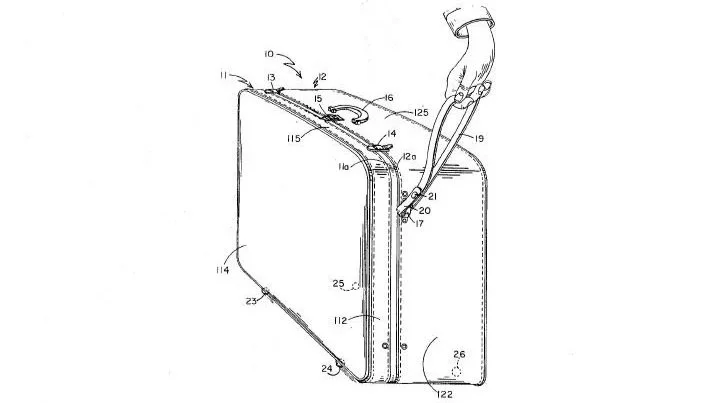
In last week’s post, I briefly mentioned how rolling luggage was invented. Here’s the story.
It is 1970, and Bernard Sadow is sweating. He is dragging two enormous suitcases through a customs hall in Puerto Rico, returning from a family holiday in Aruba. Every few steps, he has to stop, set the heavy bags down, flex his aching, blistered fingers and catch his breath. All around him, thousands of other travellers are doing exactly the same thing. Businessmen in tailored suits, exhausted parents with toddlers. All leaning sideways, faces strained, lugging dead weight by tiny leather handles.
This was the golden age of aviation. Humanity had just put a man on the moon. Yet down here on Planet Earth, our most advanced method for moving luggage through a vast, modern airport was the same one used by medieval peasants: pick it up and carry it.
As Sadow pauses to wipe his forehead, an airport worker glides past. He is effortlessly pulling a heavy piece of machinery on a wooden pallet fitted with four caster wheels.
Sadow stares at the gliding machine. Then he looks down at his immobile suitcases. Then back at the worker. Millions of people had complained about heavy luggage for decades. Some had even tried to fix it. But nobody had made it stick, because nobody was really asking the obvious question.
Why are we tolerating this?
Sadow had collided with what I call a normalised frustration.
When a struggle is new, it is irritating. But when a struggle persists for years, human beings do something remarkable: we adapt. We accept the friction as the inevitable cost of doing things. Lugging heavy bags through endless terminals was exhausting, but for travellers in 1970, it was simply the price of a plane ticket.
Sadow refused to accept that. He went home, took a standard suitcase, attached four caster wheels to the bottom, added a strap to the front and built a prototype. Two years later he patented it.
Then something revealing happened. He took his rolling suitcase to department stores, and they turned him down. Buyers insisted nobody would want it. Some thought men would never pull a bag on wheels. The frustration was so normalised that even the people selling luggage couldn’t see the problem. It took one buyer at Macy’s to give it a chance. It sold.
Once you start looking for normalised frustrations, they are surprisingly hard to stop seeing. Think about the small frictions you’ve tolerated recently. The queue you stood in without complaint. The printer that refuses to connect to your laptop. The faff of paying at a parking meter.
Every one of them is worth questioning, and any one of them could become a business opportunity. Ask yourself:
Why am I tolerating this?
Sadow’s story shows that most opportunities don’t come from the future. They’ve been hiding in plain sight all along.
This story is one of many in my book, The Insightful Entrepreneur: Why Some People See What Others Miss, out in January 2027. It’s a book about entrepreneurial insight as a practice you can learn, not a trait you’re born with.
Want the next story before the book is out? Sign up below.