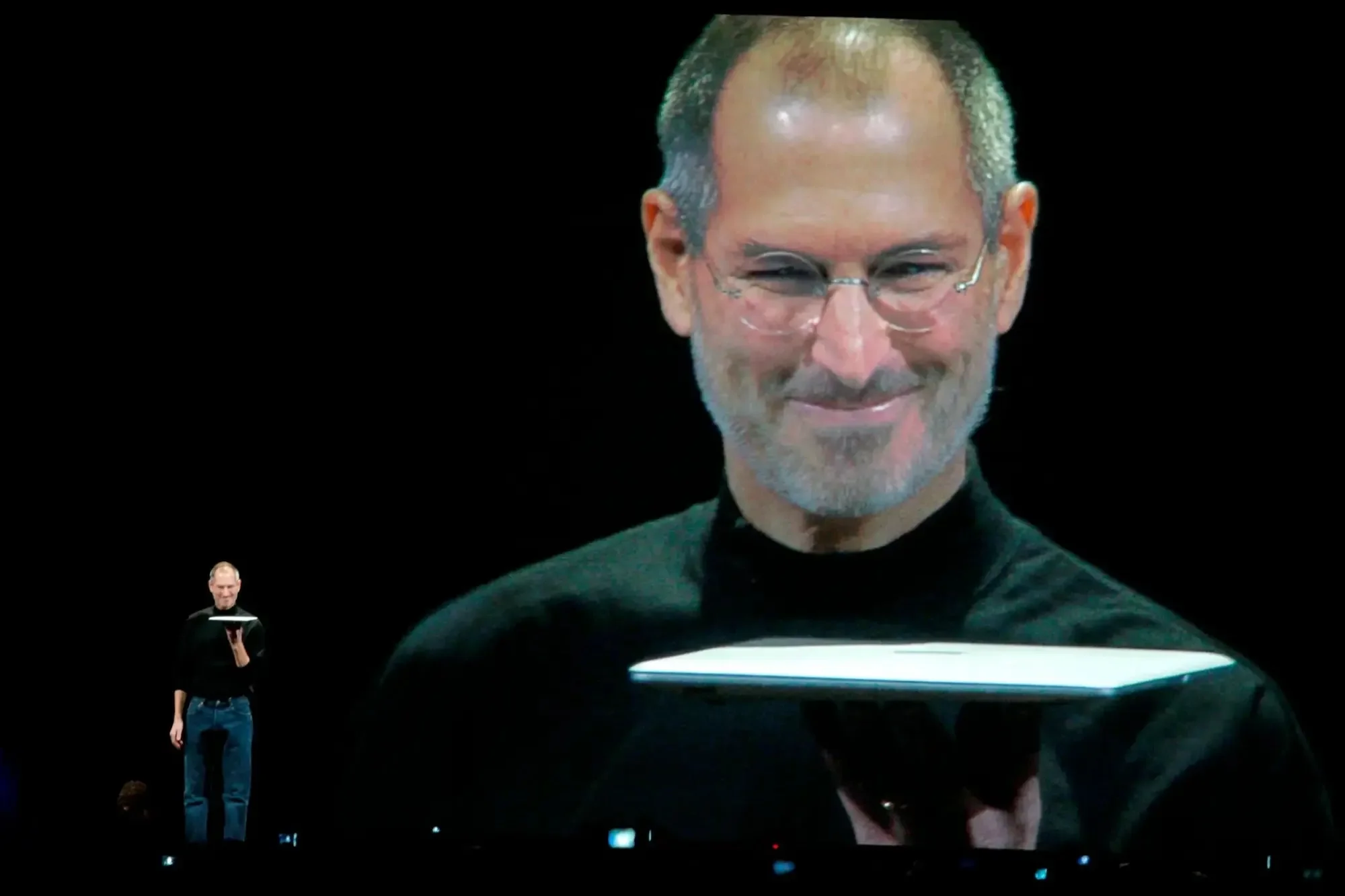
When I ask students in my entrepreneurship classes who comes to mind when they hear the word ‘entrepreneur’, the same person is named without fail: Steve Jobs. Would he be your choice too?
With his signature blue jeans and black turtleneck, he’s often pictured as a single figure on a big stage. A hero to many. A bold, driven individual who overcomes obstacles to achieve his singular vision.
This is the myth of the entrepreneur. A visionary. Someone who sees the future before the rest of us.
Yet this story we tell ourselves is wrong in almost every aspect.
So where did this myth come from?
We can trace it back to the economist Joseph Schumpeter. Writing in the early twentieth century, he described the entrepreneur as a figure driven by a near-heroic ‘will to conquer’, someone who breaks through the ordinary economic order through sheer force of personality.
Decades later, Ayn Rand’s novels, notably The Fountainhead and Atlas Shrugged, gave that figure a moral shine. They feature an exceptional individual, unappreciated by the masses, who reshapes the world through uncompromising self-belief.
This image didn’t stay in economics textbooks or novels. It migrated, almost intact, into how Silicon Valley talks about itself, and it shapes who gets backed as investors look for the next Howard Roark, the hero of The Fountainhead.
A story we’ve come to love
Walk through any airport bookshop and you’ll see familiar faces staring out from the business section: Richard Branson, Elon Musk and, of course, Steve Jobs. Business magazines celebrate their brilliance. Business school case studies deify them, as do ad agencies and brand consultancies. Hollywood makes films about them. All of this keeps the myth alive.
But the myth doesn’t hold up
Even Jobs doesn’t fit. Steve Wozniak designed and built the first Apple computer. Jobs was pushed out of his own company in 1985, and Apple’s later revival depended on a team, not a lone hero.
When I began researching real entrepreneurial stories, very few matched the archetype. Instead, I found that the most successful entrepreneurs pay the closest attention to others, not to themselves. They see frustrations that others have normalised. They notice needs that others haven’t articulated. They sense tensions in people’s lives that nobody has yet resolved.
Take Bernard Sadow. He didn’t invent the wheeled suitcase through some grand vision. Hauling heavy bags through an airport, he noticed a worker rolling a heavy load on a wheeled pallet, and saw what everyone else had walked straight past.
Why it matters
This myth isn’t only inaccurate; it’s damaging. It implies that entrepreneurs are born, not made, and that the rest of us, who experience doubt and uncertainty, aren’t made of the right stuff. It tells people with excellent instincts, genuine curiosity and real capability that entrepreneurship isn’t for them.
As a teacher of innovation and entrepreneurship, I found this disheartening. So I decided to write a book that challenges the belief that being entrepreneurial requires you to be a special kind of person.
Instead, I found that seeing opportunities, the foundational entrepreneurial skill, is a capability anyone can develop. The stories in the book all point to the same conclusion: none of these people relied on an innate gift the rest of us lack. They learnt to pay a specific kind of attention in moments when most people paid none.
This is the opening argument of my book, The Insightful Entrepreneur: Why Some People See What Others Miss, which will be published in January 2027.
Over the coming months, this blog series will share excerpts from the book: the key stories I discovered, the lessons I learnt, and what stops us seeing clearly, along with what we can do about it.
The opportunities were always there. They still are.
The question is whether you’re looking.
To receive these posts via email every week, please sign up below.